Global Procurement & Future Outlook Future Procurement Trends in Heavy Duty Industrial Racking
The global warehousing landscape is undergoing the fastest structural transformation in logistics history. Procurement leaders, operations vice presidents, and industrial developers no longer treat heavy duty industrial racking as static warehouse equipment. Today, heavy duty racking serves as an active structural infrastructure system integrated with autonomous mobile robots (AMRs), automated storage and retrieval system (ASRS) cranes, automated guided vehicles (AGVs), and sophisticated Warehouse Management Systems (WMS).
As global enterprises re-evaluate supply chain resilience, four major procurement trends have emerged that dictate how heavy duty industrial racking is engineered, specified, and purchased worldwide:
1. Convergence of Automation, ASRS, and High-Tolerance Structural Racking
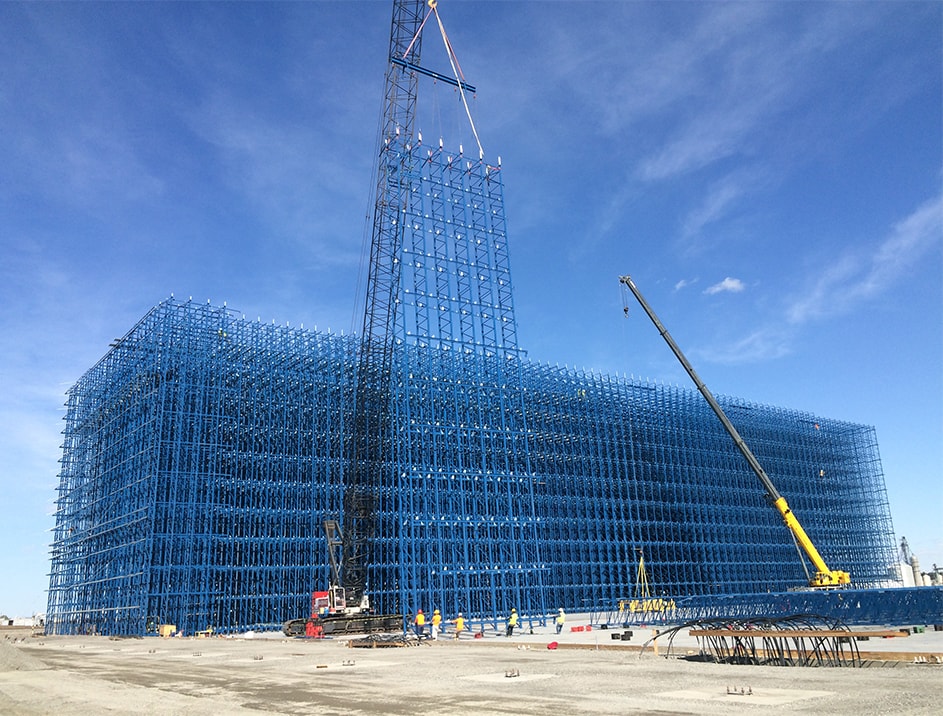
Rising labor scarcity and escalating warehouse land costs have rendered conventional 30-foot clear-height warehouses economically inefficient in tier-one metropolitan logistics corridors. Supply chain directors are aggressively pivoting toward automated high-bay facilities reaching 100 to 140 feet in vertical height. At these extreme vertical scales, standard roll-formed racking fails due to cumulative deflection, thermal expansion variance, and torsional instability under dynamic crane acceleration forces.
Frazier Industrial Racking Systems Co., Ltd. works directly with top-tier global automation integrators to design structural high-bay racking systems with tighter fabrication tolerances (often within ±1.5 mm across a 100-foot vertical span). Structural hot-rolled steel channels maintain stringent beam deflection limits (exceeding L/600 tolerances), guaranteeing that robotic sensor heads, laser navigation guides, and automated shuttle wheels never snag or experience positioning fault codes.
2. The TCO Revolution: Prioritizing Lifecycle Durability Over Initial CAPEX
Historically, procurement departments evaluated heavy duty racking bids primarily on initial capital cost per pallet position. However, financial teams at leading distribution centers have uncovered the hidden cost penalty of lightweight roll-formed teardrop systems: chronic structural damage from forklift bumper impacts, frequent upright column replacements, emergency unload shutdowns, and recurrent safety compliance fines.
By switching to Frazier 100% hot-rolled structural steel C-channel systems, enterprise operators eliminate the recurring maintenance cycle. Structural steel possesses superior yield strength and energy-absorption capacity, resisting impacts that buckle conventional thin-gauge tubular steel. Bolted frame designs also allow isolated damaged components to be unbolted and swapped out in minutes without unloading adjacent bays. This engineering reliability is backed by our signature 2-Year Rack Damage Warranty, lowering Total Cost of Ownership (TCO) by up to 45% over a 15-year lifecycle.
3. Decarbonization, ESG Standards, and USMCA Nearshoring Stability
Global corporations face increasing pressure to verify the carbon footprint and ethical sourcing of warehouse equipment. Cold-formed steel imported via long-distance maritime freight generates heavy Scope 3 carbon emissions and leaves enterprise projects vulnerable to volatile shipping tariffs, geopolitical choke-points, and unpredictable lead times.
With 10 advanced manufacturing facilities across the United States, Canada, and Mexico, Frazier Industrial Racking Systems Co., Ltd. provides local, USMCA-compliant structural steel production. Our hot-rolled steel utilizes high percentages of recycled scrap steel melted in electric arc furnaces (EAF), delivering measurable embodied carbon reductions. Regional fabrication slashes freight transit distances, keeps delivery dates locked in place, and ensures predictable project timelines from concept to certificate of occupancy.
4. Seismic Resiliency and Modern Building Code Harmonization
Industrial racking systems installed across seismic hazard zones—such as the Pacific Rim, the New Madrid Seismic Zone, and major parts of Western Canada and Mexico—must satisfy rigorous earthquake design criteria governed by ANSI MH16.1, IBC 2024, and ASCE 7. Procurement teams now mandate pre-engineered, PE-stamped structural calculations that evaluate soil-structure interaction, beam ductile moment frames, base-plate anchor elongation, and dynamic pallet retention systems.
Our experienced structural engineering division calculates specific Seismic Design Categories (SDC C through F) for each facility footprint. We engineer oversized hot-rolled baseplates, specify concrete anchor embedment depths up to 8 inches, and integrate structural diagonal bracing trusses to ensure uninterrupted facility survival during major seismic events.
Technological Trends Shaping the Future of Heavy Duty Racking Systems
Looking ahead toward 2030, industrial storage racks will evolve into intelligent, data-generating logistics nodes. Emerging advancements actively engineered by Frazier Industrial Racking Systems Co., Ltd. include:
IoT-Enabled Structural Health Monitoring
Heavy duty upright frames and baseplates are being instrumented with wireless tri-axial accelerometer sensors and strain gauges. These IoT nodes monitor live floor vibration, structural deflection, and accidental forklift impacts in real time. If an impact exceeds permissible load thresholds, the system instantly alerts warehouse safety supervisors and flags the exact coordinate in the facility digital twin model for immediate inspection.
Hybrid Multi-Directional Pallet Shuttle Integration
To eliminate dedicated forklift aisles completely, modern cold storage and high-density distribution centers are adopting multi-directional autonomous pallet shuttles that navigate structural steel rails inside deep racking channels. Frazier's rigid hot-rolled channel profiles provide the stable rolling surface required to eliminate shuttle wheel slip, vibration, and rail misalignments under high-speed robotic duty cycles.
Modular Rack Supported Enclosures for Cold Logistics
In temperature-controlled food logistics and pharmaceutical cold chains, rack supported buildings are replacing traditional construction. By utilizing the heavy duty racking uprights to directly hang insulated freezer panels and support roof truss loads, operators can achieve faster building completion, optimize refrigeration volume efficiency by up to 35%, and leverage accelerated structural tax depreciation schedules.